Creating Bond Tokens
Learn how to create bond tokens representing debt securities with maturity dates and coupon payments using the ATS web application.
Overview
Bond tokens represent debt securities issued by companies or organizations. They include features like:
- Fixed maturity date for principal redemption
- Periodic coupon (interest) payments to bondholders
- Transfer restrictions and compliance rules
- Configurable payment schedules and terms
Bond Types
ATS supports four types of bonds at the smart contract level, each designed for different use cases:
| Bond Type | Description | Use Case |
|---|---|---|
| Standard | Basic bond with configurable coupon rates | Traditional corporate bonds, government bonds |
| Fixed Rate | Bond with a predetermined fixed interest rate | Predictable income securities, savings bonds |
| KPI Linked Rate | Interest rate linked to Key Performance Indicators | Performance-based bonds, ESG-linked debt |
| Sustainability Performance Target Rate | Rate tied to sustainability/ESG performance targets | Green bonds, sustainability-linked bonds |
Note: The web application creates standard bonds by default. For specialized bond types (Fixed Rate, KPI Linked, Sustainability Performance Target), use the SDK or contract deployment scripts directly. See the Developer Guide for details.
Prerequisites
- ATS web application running and accessible
- Hedera wallet connected (HashPack, Blade, or MetaMask)
- Sufficient HBAR for transaction fees
- Business Logic Resolver and Factory contracts deployed
Getting Started
- Open the ATS web application
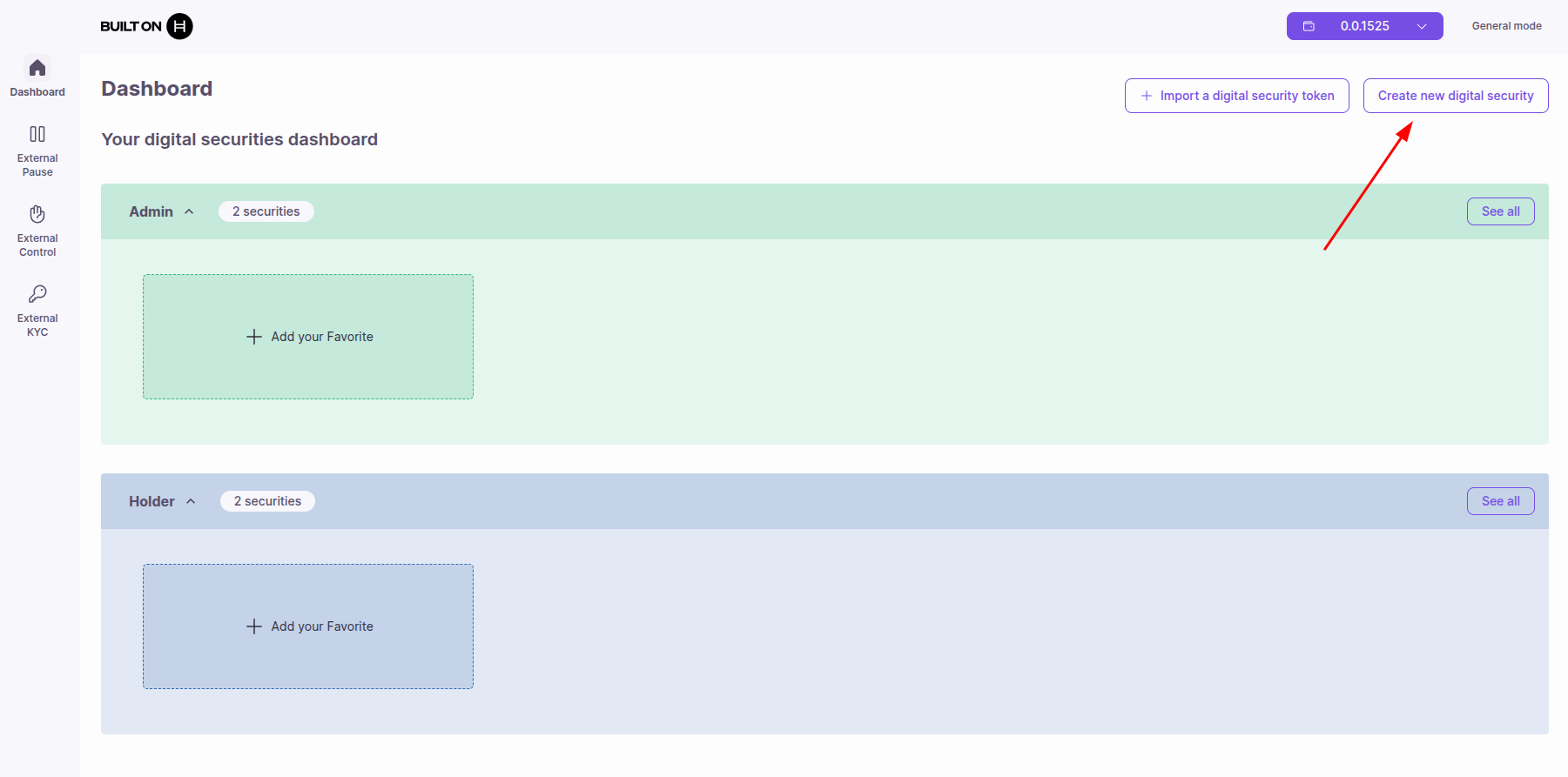
- Click "Create Token" in the navigation menu
- Select "Bond" as the token type
Step 1: Bond Details
General Information
Name: The full name of your bond security
- Example: "Acme Corporation 5-Year Bond"
- Include issuer name and key terms
Symbol: A short ticker symbol (2-8 characters)
- Example: "ACME-BOND" or "ACME5Y"
- Recommended format:
[ISSUER]-[TYPE][TERM]
Decimals: Number of decimal places for bond units
- Typical value: 6 (allows fractional bonds)
- Use 0 for whole bonds only
- Use higher values (6-8) for institutional-grade bonds
ISIN: International Securities Identification Number
- Format: 2-letter country code + 9 alphanumeric characters + 1 check digit
- Example:
US9311421039 - Must follow the ISO 6166 standard format
- Required for regulatory compliance and international trading
Bond Permissions
Configure administrative permissions for the bond token:
Controllable
- Purpose: Enable forced transfers and balance adjustments
- When enabled: Grants CONTROLLER_ROLE the ability to:
- Force transfer bonds between accounts (e.g., court orders)
- Adjust balances for regulatory compliance
- Execute restructuring operations
- Use cases: Debt restructuring, regulatory requirements, lost key recovery
- Recommendation: Enable only if required by regulation or corporate policies
Blocklist (Blacklist)
- Purpose: Block specific addresses from holding bonds
- How it works: Addresses on the list cannot receive or hold bond tokens
- Use cases: Sanctioned entities, defaulted bondholders, regulatory blacklists
- When to use: When you want to block specific addresses but allow everyone else
Approval list (Whitelist)
- Purpose: Only approved addresses can hold bonds
- How it works: Only addresses on the list can receive bond tokens
- Use cases: Qualified institutional buyers (QIBs), accredited investors only
- When to use: When you want to restrict bond ownership to pre-approved addresses only
Important: You must choose either blocklist or approval list (whitelist), not both. They are mutually exclusive options.
Bond Configuration
Clearing Mode Enabled
- Purpose: Require validator approval for all transfers and redeems
- What it does:
- Users must submit transfer/redeem requests
- Validators (CLEARING_VALIDATOR_ROLE) must approve before execution
- Enables regulatory oversight of all token movements
- When to enable:
- Regulatory compliance requires approval workflow
- Jurisdiction-specific rules need validation
- Manual review required for transfers
- Roles activated: CLEARING_ROLE, CLEARING_VALIDATOR_ROLE
Learn more: See Clearing Operations for complete guide on using clearing mode.
Internal KYC Activated
- Purpose: Enable/disable internal KYC verification
- Flag: Controls whether token uses its own KYC registry
- When enabled: Token checks internal KYC registry before allowing transfers
- When disabled: Only external KYC lists and SSI are checked
- Use cases:
- Enable: Use token's own bondholder verification database
- Disable: Rely entirely on external KYC providers or SSI
Tip: You can use Internal KYC + External KYC Lists + SSI simultaneously. Any method granting KYC allows the transfer.
Step 2: Bond Configuration
Bond Terms
Currency
- Value: USD (US Dollar)
- Purpose: Currency for bond denomination and payments
- Note: Currently fixed to USD, cannot be changed. All coupon payments and redemptions use USD
Number of Bond Units
- Definition: Total number of bond units to issue
- Example: 10,000 bonds
- Considerations:
- Smaller issuances: 100-1,000 bonds
- Medium issuances: 1,000-100,000 bonds
- Large issuances: 100,000+ bonds
- Note: With decimals enabled, each unit can be fractional
Nominal Value (Face Value)
- Definition: Par value of each bond unit
- Example: $1,000 per bond (standard corporate bond)
- Common values:
- Corporate bonds: $1,000 or $5,000
- Government bonds: $1,000, $5,000, $10,000
- Institutional bonds: $100,000 or $1,000,000
- Use: Determines principal amount paid at maturity
Total Value
- Calculation: Automatically computed
- Formula: Number of Bond Units × Nominal Value
- Example: 10,000 bonds × $1,000 = $10,000,000 total value
- Note: This is the total principal amount to be raised
Bond Dates
Starting Date (Mint Date)
- Definition: Date when bonds are issued and start accruing interest
- Also called: Issue date, settlement date
- Considerations:
- Must be present or future date
- First coupon period starts from this date
- Use: Determines when bondholders can start trading
Maturity Date
- Definition: Date when bond principal is redeemed
- Requirements: Must be after starting date
- Considerations:
- Short-term: 1-3 years
- Medium-term: 3-10 years
- Long-term: 10+ years
- Use: Determines when ISSUER must repay principal to bondholders
Important: Coupon payment schedule is configured separately through the Corporate Actions interface after deployment.
Step 3: Proceed Recipients
Proceed recipients are addresses that receive funds when bonds are issued or sold. This is optional but commonly used for treasury management.
What are Proceed Recipients?
- Purpose: Automatically distribute bond proceeds to designated addresses
- Use cases:
- Treasury wallet receives proceeds
- Multi-signature wallets for corporate governance
- Split proceeds between operating and reserve accounts
- Escrow arrangements
Adding Recipients
Address
- Format: Hedera Account ID (
0.0.xxxxxxx) or EVM address (0x...) - Example:
0.0.1234567or0x742d35Cc6634C0532925a3b844Bc454e4438f44e - Validation: Must be valid Hedera account or EVM address
Data
- Purpose: Optional field for notes or reference information
- Format: Free text field
- Example:
Treasury wallet,Operating account,Reserve fund - Note: This is for informational purposes only
Proceed Recipients Table
After adding recipients, they appear in a table:
| Address | Data | Actions |
|---|---|---|
| 0.0.1234567 | Treasury wallet | Remove |
| 0.0.7654321 | Operating account | Remove |
Actions Available:
- Remove: Delete a recipient from the list
Tip: You can add multiple recipients to receive bond proceeds.
Step 4: ERC-3643 Integration (Optional)
For advanced compliance features, integrate ERC-3643 (T-REX) contracts. This step is optional but provides enhanced regulatory compliance capabilities for bond offerings.
Note: Bond tokens created by ATS are already compatible with ERC-3643 operations by default. ATS implements partial ERC-3643 (T-REX) compliance as part of its core architecture. This integration step is only required if you need full ERC-3643 standard compatibility with advanced T-REX features like custom Compliance Modules and Identity Registries. See Developer Guide: ATS Contracts for architecture details.
Compliance Module
Purpose: Enforces transfer rules and regulatory requirements
- What it does: Validates all bond transfers against compliance rules
- Use cases:
- Complex regulatory requirements for cross-border bonds
- Multi-jurisdiction debt offerings
- Institutional-grade compliance
- Configuration: Requires deploying a Compliance Module contract
Identity Registry
Purpose: Manages verified bondholder identities
- What it does: Maintains on-chain registry of verified bondholder identities
- Use cases:
- Enhanced KYC management for bondholders
- Investor identity verification
- Regulatory reporting requirements
- Configuration: Requires deploying an Identity Registry contract
Important: Both Compliance Module and Identity Registry must be deployed before token creation. See Deployment Guide for instructions.
When to Use ERC-3643
Use this step only if you need full compatibility with the ERC-3643 standard:
- Standard compliance: Need to ensure full compatibility with ERC-3643 (T-REX) specification
- Interoperability: Bond token must work with other ERC-3643 compliant systems
- Third-party integrations: Integration with platforms that require ERC-3643 compliance
- Ecosystem compatibility: Participating in ERC-3643 token ecosystems
When to Skip
- Most use cases: ATS already provides partial ERC-3643 compliance for typical bond token operations
- Custom compliance: If you just need complex compliance, use ATS's built-in features (Internal KYC, External KYC Lists, Control Lists, Clearing Mode, etc.)
- Testing/Development: Prototyping bond structures without standard requirements
Step 5: External Lists Configuration
In this step, you can link previously created external lists to your bond token. These are optional but recommended for multi-token issuers.
External Pause Lists
External pause contracts allow coordinated pausing across multiple bonds:
- What are they: On-chain smart contracts that can pause all linked bonds
- Where to configure: Sidebar menu → External Pause
- Use cases: Platform-wide emergency stops, coordinated system upgrades, crisis management
- How it works: If any linked pause contract returns
isPaused() = true, bond is paused - Link: Managing External Pause Lists
How to link:
- Select from dropdown: All your created pause contracts appear
- Add to token: Click to link pause mechanism
- View linked: See all currently linked pause contracts
- Remove: Unlink if no longer needed
External Control Lists
External control lists are reusable whitelists/blacklists shared across multiple bonds:
- What are they: On-chain smart contracts managing approved/blocked addresses
- Where to configure: Sidebar menu → Control Lists
- Use cases: Shared regulatory blacklists, multi-bond whitelists for institutional investors
- Link: Managing External Control Lists
How to link:
- Select from dropdown: All your created control lists appear
- Add to token: Click to link whitelist or blacklist
- View linked: See all currently linked control lists
- Remove: Unlink if no longer needed
External KYC Lists
External KYC lists verify bondholder identity across multiple bonds:
- What are they: On-chain smart contracts managing KYC-verified investors
- Where to configure: Sidebar menu → External KYC
- Use cases: Shared bondholder verification, third-party KYC providers, institutional investor registries
- Link: Managing External KYC Lists
How to link:
- Select from dropdown: All your created KYC lists appear
- Add to token: Click to link KYC verification list
- View linked: See all currently linked KYC lists
- Remove: Unlink if no longer needed
Tip: You can create external lists from the sidebar before or after bond creation.
Step 6: Regulation
Important: Consult your legal and financial advisor for regulations applicable to your bond offering.
Jurisdiction
The primary jurisdiction for your bond offering:
- United States
Select Regulation
Choose the regulatory framework for your bond offering:
Regulation S
Purpose: Debt offerings outside the United States to non-U.S. persons
Restrictions and Rules:
| Rule | Details |
|---|---|
| Deal size | Can raise unlimited capital |
| Accredited investors | Accreditation required |
| Max non-accredited investors | Unlimited |
| Manual investor verification | Verification of investors' financial documents required |
| International investors | Allowed |
| Resale hold period | Not applicable |
Use cases:
- International bond offerings
- Eurobonds and global bonds
- Non-U.S. bondholder base
- Cross-border debt financing
Regulation D 506(b)
Purpose: Private debt placement in the United States
Restrictions and Rules:
| Rule | Details |
|---|---|
| Deal size | Can raise unlimited capital |
| Accredited investors | Accreditation required |
| Max non-accredited investors | 35 maximum |
| Manual investor verification | Verification of investors' financial documents required |
| International investors | Not allowed |
| Resale hold period | Applicable from 6 months to 1 year |
Use cases:
- U.S.-based private bond placements
- Qualified institutional buyers (QIBs)
- Accredited investor bond offerings
- Limited retail bondholder participation
Warning: Read the restrictions carefully. These details cannot be altered once the bond is deployed.
Geographic Block List
Purpose: Specify countries whose residents cannot purchase bonds
How it works:
- Based on selected regulation
- Can add additional blocked countries beyond regulatory requirements
- Enforced via compliance checks during bond transfers
Common restrictions:
- OFAC sanctioned countries
- High-risk jurisdictions for money laundering
- Countries with conflicting securities regulations
Example: Block sanctioned countries or jurisdictions with capital controls
Step 7: Review and Deploy
Review Configuration
Before deploying, verify all bond configuration details:
- Bond details: Name, symbol, decimals, ISIN
- Permissions: Controllable, blocklist, approval list settings
- Configuration: Clearing mode, internal KYC status
- Bond terms: Currency, bond units, nominal value, total value
- Bond dates: Starting date (mint date), maturity date
- Proceed recipients: All recipients added with correct percentages (totaling 100%)
- External lists: Correct lists linked (if any)
- ERC-3643: Compliance Module and Identity Registry addresses (if used)
- Regulation: Proper regulation selected, geographic block list configured
Deployment Cost
- View estimated HBAR cost for deployment
- Includes: Factory contract call, proxy deployment, initial configuration
- Typical cost: 50-200 HBAR (varies by network congestion)
- Note: Bond deployment may cost slightly more than equity due to additional bond-specific features
Deploy Bond
- Click "Deploy Bond" button
- Approve transaction in your wallet
- Wait for confirmation (typically 3-5 seconds on Hedera)
- Contract address will be displayed on success
Verify Deployment
After successful deployment:
Bond Information
- Contract Address: EVM address of deployed bond (0x...)
- Contract ID: Hedera contract ID (0.0.xxxxx)
- Factory: Factory contract that deployed the bond
- Deployment Time: Timestamp of deployment
View in Dashboard
- Bond appears in your "My Tokens" list
- Click to view bond details
- Available tabs (based on your role):
- Overview: Bond info, supply, bondholders, maturity countdown
- Holders: List of bondholders and balances
- Transfers: Transfer history
- Corporate Actions: Coupon payment management, maturity redemption
- Compliance: KYC, control lists
- Settings: Bond configuration
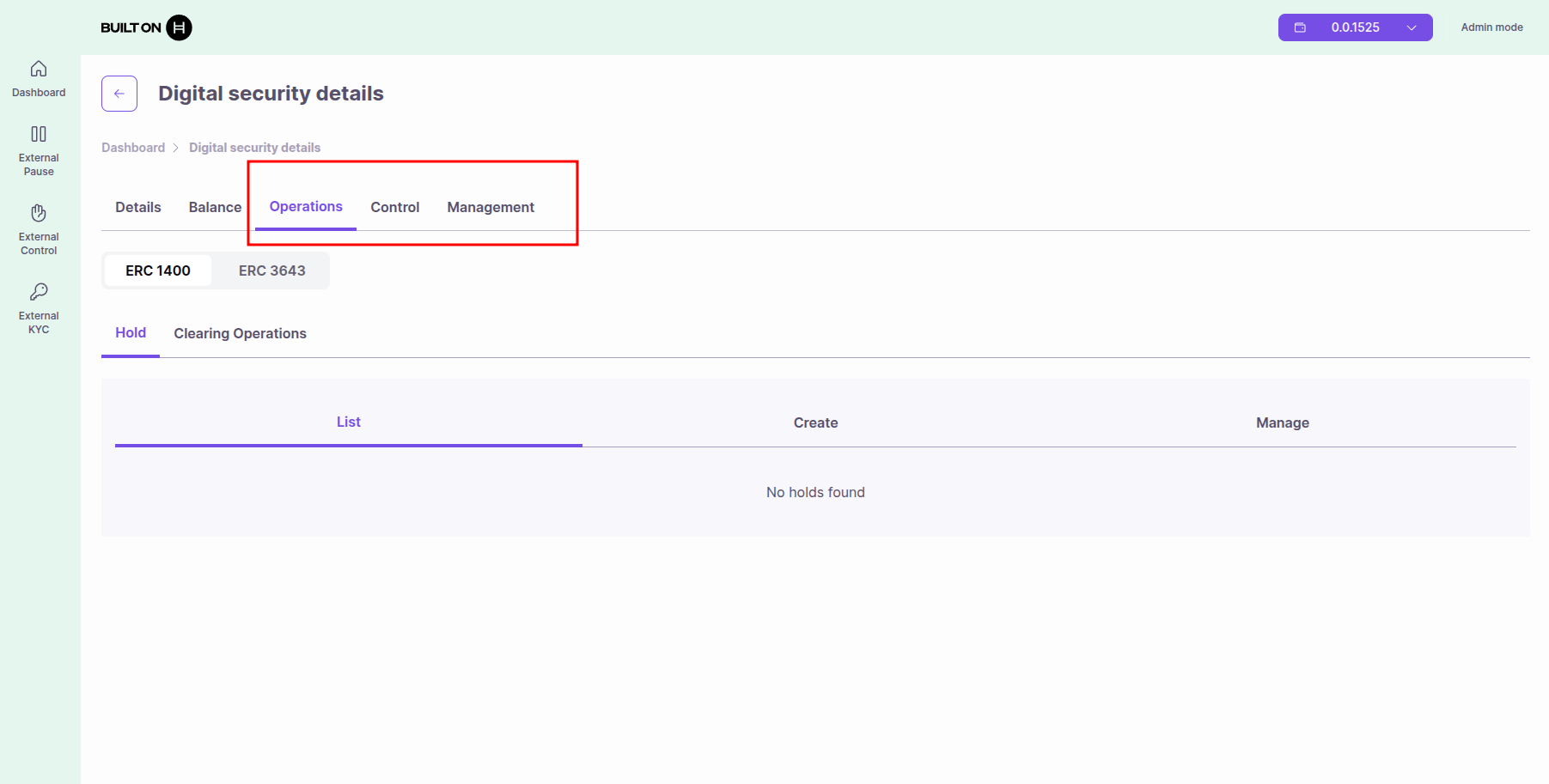
Note: Available tabs depend on your assigned roles. See Roles and Permissions.
Managing Your Bond Token
After creation, you can manage your bond from the dashboard. Select Admin View (green) to access administrative operations or Holder View (blue) to view balances and transfer tokens.
Common bond lifecycle management operations:
Distribute Bonds
- How: Transfer tab or issue function
- Requirements: ISSUER_ROLE
- Recipients: Must pass KYC and control list checks
- Use cases: Initial bond distribution to underwriters, direct sales to investors
Execute Coupon Payments
- How: Corporate Actions tab → Create Coupon Payment
- Requirements: CORPORATE_ACTION_ROLE
- Process:
- Create snapshot of bondholders at record date
- Specify coupon amount (interest payment)
- Execute distribution to all bondholders
- Frequency: Based on bond terms (monthly, quarterly, semi-annually, annually)
Handle Maturity Redemption
- How: Corporate Actions tab → Maturity Redemption
- Requirements: CORPORATE_ACTION_ROLE
- Process:
- At maturity date, create final snapshot
- Calculate principal + final coupon
- Execute redemption to all bondholders
- Bond tokens are burned upon redemption
Manage Compliance
- KYC: Grant/revoke KYC status for bondholders
- Control Lists: Add/remove addresses from whitelist/blacklist
- Freeze: Freeze specific bondholder accounts if needed (regulatory requirements)
Pause Transfers
- How: Settings → Emergency pause
- Requirements: PAUSER_ROLE
- Effect: All bond transfers blocked until unpause
- Use cases: Security incidents, regulatory investigations, system maintenance
Common Issues
Transaction Failed
- Insufficient HBAR: Ensure wallet has enough HBAR for gas fees (check estimated cost)
- Invalid Configuration: Verify all required fields are filled correctly
- Contract Not Found: Check Factory contract address in your .env configuration
- Invalid Dates: Ensure maturity date is after starting date
Proceed Recipients Errors
- Percentages don't add to 100%: Verify all recipient allocations sum to 100%
- Invalid Address: Check that addresses are valid Hedera IDs or EVM addresses
- Duplicate Recipients: Remove duplicate addresses before deployment
KYC Errors
- KYC check fails: Verify bondholder is KYC-verified (internal, external, or SSI)
- External list not found: Ensure external KYC list address is correct
- SSI not configured: If using SSI, verify revocation registry and issuers are set
Transfer Restrictions
- Blocklist blocking: Check if recipient is on blocklist (internal or external)
- Approval list missing: If approval list enabled, ensure recipient is approved
- Regulation block: Verify recipient's jurisdiction is not blocked
Control List Issues
- Internal vs External: Remember both internal and external lists are checked
- Wrong list type: Verify you're using control lists (not KYC lists) for transfer control
Bond Lifecycle Issues
- Coupon payment failed: Ensure sufficient funds in payment token contract
- Maturity date misconfigured: Verify maturity date is set correctly during creation
- Missing CORPORATE_ACTION_ROLE: Grant role to accounts responsible for coupon payments
Next Steps
- Token Operations - Learn about all available operations for your bond
- Corporate Actions - Execute coupon payments and maturity redemption
- Managing KYC & Compliance - Set up bondholder verification
- Roles and Permissions - Grant roles to team members
- SSI Integration - Decentralized identity verification with Terminal 3
- Managing External KYC Lists - Configure external verification
- Managing External Control Lists - Configure transfer restrictions